
Timing a Custom Scent for Body Care: The Loops That Add Weeks
A custom fragrance timeline is rarely late because the perfumer is slow. It runs long because five or six small loops sit inside the schedule, and each one waits for a decision that nobody diarised. The loops are predictable: brief clarification, sampling rounds, base compatibility, stability, packaging approval and bulk scheduling. This article maps them for a body care line, shows which ones you control and which ones the factory controls, and explains why compressing the wrong loop buys a week and costs a season.
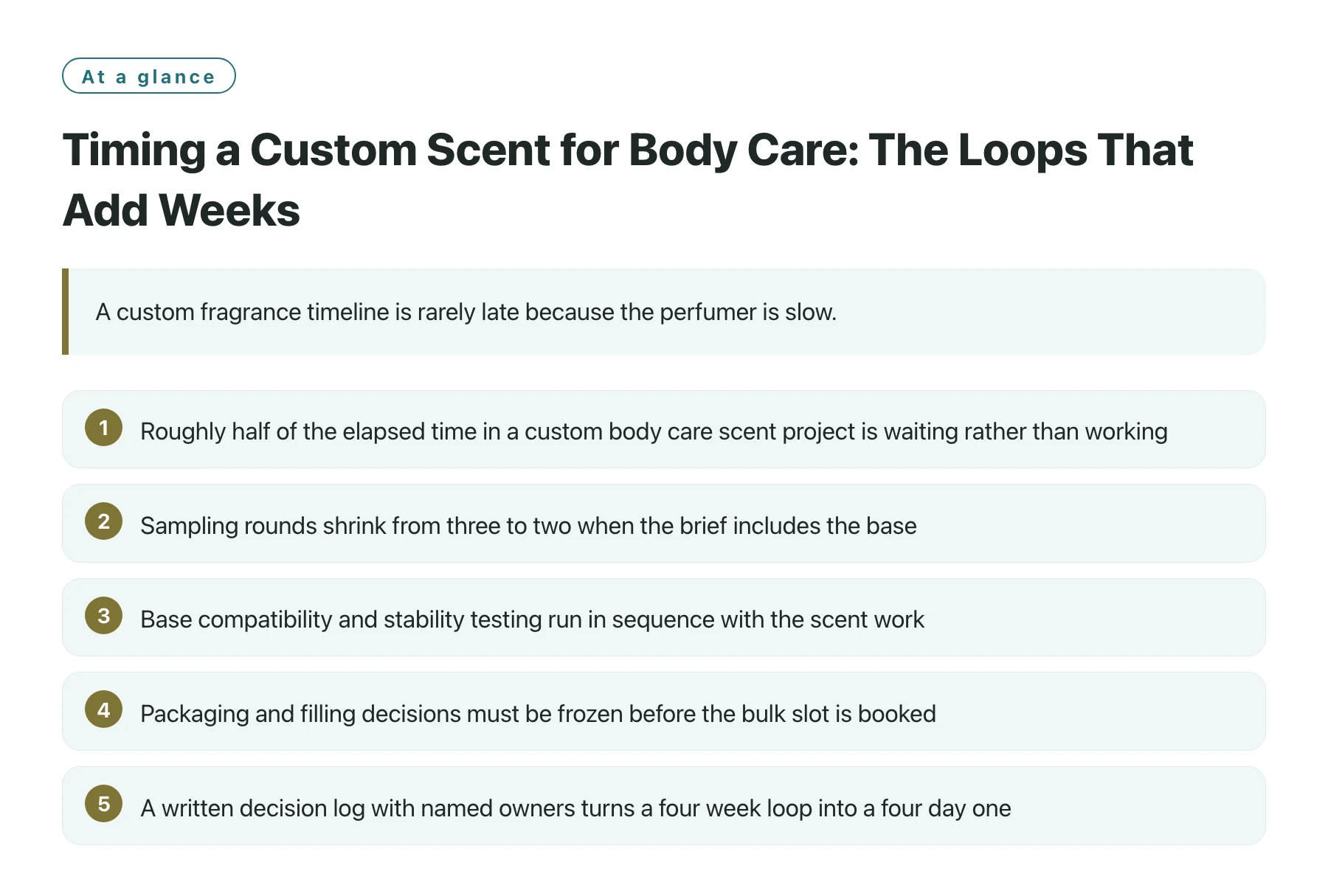
Key takeaways
- Roughly half of the elapsed time in a custom body care scent project is waiting rather than working, and most of that waiting is triggered by an unanswered question.
- Sampling rounds shrink from three to two when the brief includes the base, the dosage range, the target markets and a reference the brand actually likes.
- Base compatibility and stability testing run in sequence with the scent work, not after it, and pulling them forward is the single largest schedule saving available.
- Packaging and filling decisions must be frozen before the bulk slot is booked, because tooling and component lead times sit outside the factory's control.
- A written decision log with named owners turns a four week loop into a four day one, because it removes the search for who was supposed to answer.
Project managers in this category tend to plan from the launch date backwards, which is correct, and then assume the middle of the plan behaves like a production line, which is not. Fragrance development is a series of confirmations. Each confirmation has a queue on both sides, and a queue that begins on a Friday afternoon usually costs a weekend.
The useful way to read a custom fragrance schedule is therefore not as a list of stages but as a set of loops. A loop has one question, two parties waiting on each other, and a decision that releases the next step. Count the loops and you can predict the calendar far more accurately than by adding up the quoted durations.
Six loops in a custom body care scent project
| Loop | Why it exists | Typical extra time | How to close it faster |
|---|---|---|---|
| Brief clarification | The brief names a mood but not a format, market or dosage range | One to two weeks of email round trips | Send one page: format, base, target markets, dosage band, reference products |
| Sampling rounds | Each round tests a different interpretation of the same words | Two to three weeks per round | Limit each round to three directions and give written reactions within three days |
| Base compatibility | An accord that works in alcohol may change colour or intensity in a wash or lotion | Two to four weeks if handled separately | Ask the factory to test in your base from the first submission |
| Stability and safety testing | Heat, cold and time change both the scent and the base | Four to eight weeks, partly calendar time | Start it on the first direction that survives the brand review, not on the final choice |
| Packaging and component approval | Bottles, pumps and decoration have their own lead times and proofs | Two to six weeks outside the factory | Freeze the pack before sampling ends; do not treat it as a launch-week task |
| Bulk scheduling | The line slot and the material order are separate queues | Two to four weeks of queue | Book the provisional slot when the pilot is approved, not when the label is final |
The durations are typical rather than fixed; what matters is that each loop has an owner and a written release condition.
What a body care base does to the clock
Compatibility is a separate test, not a formality
In a surfactant or emulsion system the fragrance meets surfactants, preservatives, pH adjusters and water. The same accord can lose its top notes, turn the base cloudy or accelerate discolouration. A substance and its behaviour in a given product type is exactly the kind of question a materials reference can help you frame before the first submission [1].
The schedule implication is simple. If compatibility testing starts after the scent is chosen, it is a sequential loop at the end. If it starts on the first viable direction, it runs in parallel and often finishes before the brand has made up its mind.
Two formats means two timelines that share one decision
A body wash and a body lotion built from one scent family share the creative decision but not the stability programme. Planning them as one line item hides a second test sequence. Planning them as two independent projects doubles the sampling rounds. The efficient version keeps one creative brief and two technical acceptances, with the base testing booked together.
The buyer controls more of the calendar than it feels like
In a typical project the brand owns the two slowest variables: how fast feedback arrives and how often the internal team changes its mind. Both are cheap to fix. A named decision maker, a three day response commitment and a rule that a comment must arrive as a written instruction rather than a forwarded screenshot will remove weeks from the plan.
The factory owns the other variables: queue position, lab availability, and whether it can run compatibility and stability work without booking an external lab. This is where the choice of partner shows up in the calendar. A maker that compounds, fills and tests in house keeps the loops inside one building, while a broker has to schedule each of them with someone else.
That structural difference is worth weighing before sampling starts, because switching partners mid project resets every loop at once. It is also the reason the first technical conversation should cover the whole sequence rather than only the scent, and a custom fragrance development partner should be able to describe that sequence in stages with the dependencies named.
A schedule that survives contact with reality
- Week zero: one page, one referenceFormat, base, dosage band, markets, three reference products and a named decision maker on the brand side.
- Week one to three: three directions maximumAsk for three interpretations of the brief and written notes on how each was built, not a single polished submission.
- Week three to seven: compatibility and stability in parallelBook both on the direction that survives the internal review, and keep the losing directions on file.
- Week six to eight: freeze the packApprove bottle, pump, decoration and label copy while testing runs, so component lead times overlap rather than follow.
- Week eight onward: pilot, then hold the slotTreat the pilot as the schedule anchor. Once it passes, book bulk provisionally and keep the retained samples with their batch numbers.
Do not shorten the stability programme to protect a launch date. A four week saving on testing that then shows up as a colour shift in month three is the most expensive trade in this category, and it is visible in every unit already shipped.
Reading the loops from the supplier side
When you compare two suppliers, ask each to describe its sequence with durations and dependencies rather than a single total. A supplier that answers in stages is showing you its internal process; a supplier that answers with one number is showing you its sales process. A structured overview of the stages of perfume production is a useful thing to have open during that conversation.
For a scent built specifically for your brand rather than taken from a library, the acceptance criteria are the part to agree in writing before sampling: what the approval means, which sample becomes the reference, and what happens if the bulk drifts from it. The question of why a sample and the bulk order can differ is worth reading up on in advance, because that handover is where a schedule usually either holds or quietly slides.
Industry coverage of fragrance development is also a reasonable reality check on how long things take and where brands most often make changes, because the broad pattern in this category repeats across companies and price points [2].
Sources
- The Good Scents Company —— A reference database of aroma materials with odour descriptions, CAS numbers and typical usage information.
- Cosmetics Business —— A trade publication covering the beauty and cosmetics industry, including fragrance launches and regulatory developments.
Frequently asked questions
How long does a custom fragrance take for a body care line?
Ten to twenty weeks is a realistic band from signed brief to delivered bulk, with the spread driven by sampling rounds, base compatibility and component lead times rather than by the perfumery itself.
Can the sampling and stability phases overlap?
Yes, and they usually should. Stability work can begin on the first direction that passes internal review, which means the winning direction has a head start while the team finishes comparing samples.
Why does the same brief produce different timelines from different factories?
Because the loops land in different places. A factory with in-house compounding, filling and stability testing keeps most loops on site; a supplier that outsources them adds a queue at each handover.
What is the fastest way to lose two weeks?
Approve a sample without agreeing what it represents, then change the base or the dosage afterwards. The team effectively restarts compatibility and stability work while the schedule keeps moving.
Should the launch date or the test programme lead the plan?
Neither exclusively. Set the launch date, build the test programme backwards from it, and adjust the product scope, such as the number of formats, when the two cannot both hold.
Continue the story in person.
Reserve a suite at Elysees Hotel and let our butlers arrange every detail of your Parisian-inspired retreat.
Reserve Your Suite